Showing posts with label gospels. Show all posts

The Gospels for Prayer Review

The Gospels for Prayer
Average Reviews:

(More customer reviews)
Michael Hansen has produced an aesthetically beautiful book on how to pray with the Gospels. If you are used to reading or trying to pray with a standard bible or new testament chances are you will have lots of footnotes and comments and the text condensed into small columns on each page. Michael has produced the Gospels with the major passage from each section of the four Gospels on one page at a time, with no footnotes and not comments. It is a book that is designed to allow you to pray and enter more deeply your relationship with Jesus without distraction. Michael has also an excellent introduction outlining different ways of praying that can help you to use this book more effectively. It is a beautiful book that I cannot recomment highly enough.

Click Here to see more reviews about: The Gospels for Prayer


Buy Now

Click here for more information about The Gospels for Prayer

Read More...

Gospel Fragments (Oxford Early Christian Gospel Texts) Review

Gospel Fragments (Oxford Early Christian Gospel Texts)
Average Reviews:

(More customer reviews)
This book, which is aimed at scholars, should also be of interest to anyone intrigued by early Christianity.
P. Egerton 2, for example, caused a sensation when it was published in 1935 as the earliest Christian gospel fragment. Only a few months later it lost its place as the earliest fragment when P. Ryl.457 fragments of John's gospel, were "dated...to the reign of Hadrian" (p 12).
Nicklas argues that "The text is...interested in the relationship between Jesus and Moses" (p 37). It shows correspondences between John's gospel, but how? "Today the existence of possible sources (besides the synoptic gospels) of the Gospel of John is regarded as more and more unlikely" ( p 39). In the end, Nicklas decides the evidence shows that, while the author of P. Egerton 2 may have heard John's gospel, clearly, he did not have the gospel on hand.
Kruger investigates P.Oxy.840. This has been a frequently overlooked fragment. "Much of the neglect of P.Oxy. 840 can be attributed to the doubts raised by some scholars about the historical accuracy of some of its descriptions of the temple and its associated rituals" (p 125). Clearly, it was written by someone who was not a professional scribe.
Although some of the historical questions about this fragment seem unresolvable now, there are many fascinating questions about it. One is the use "of the term 'Savior' for Jesus" (p 159) as opposed to the canonical gospels.
Also, it clearly "lacks any obvious heterodox of 'heretical' agenda" (p 161). Could this be because it stems from early Jewish Christianity?
Each fragment discussed has a photograph of the fragment. There is also a complete Greek version of the fragment, as well as an English translation. The work of other scholars is discussed, as well as current theories about the date, origin, and meaning of the fragment.
Among the dozens of intriguing questions in this book that that beg to be answered: why are "98 percent of the non-Christian manuscripts....before 200 AD scrolls, (while) almost all extant Christian fragments of this time come from codices" (p 150). There are many theories as to why Christians used the codex. But so far, no firm answers.

Click Here to see more reviews about: Gospel Fragments (Oxford Early Christian Gospel Texts)


Buy Now

Click here for more information about Gospel Fragments (Oxford Early Christian Gospel Texts)

Read More...

The Text of the New Testament: Its Transmission, Corruption, and Restoration Review

The Text of the New Testament: Its Transmission, Corruption, and Restoration
Average Reviews:

(More customer reviews)
Dr. Metzger has given the reader an invaluable resource for the study of the text of the New Testament. The book is divided into three major parts. Part one begins with a detailed description of the ancient method of bookmaking. Next, Metzger lists the major Greek manuscripts and codices as well as a basic description of each. He also lists the major non-Greek witnesses (e.g. Syriac, Coptic, Latin, etc.) and discusses the role of quotations from the early church Fathers. Part two is devoted to the history of the printed editions of the Greek New Testament from the time of the Complutensian Polyglot and the Textus Receptus (the text used for the KJV) through Westcott and Hort until the present day. Part three is an instruction manual for textual criticism, including the many theories of criticism and the method of conjectural emendation. In this section, Metzger also discusses the many types of errors and deliberate changes made by the scribes. He then gives an analysis of several textually difficult passages (e.g. Mark 16 and Acts 20:28). The book also includes 16 photo plates that show selected manuscripts. A working knowledge of Greek is helpful because Metzger often cites Greek words in the text and footnotes without an English translation. If one wishes to learn the basics (and more) about textual criticism, then this is the book to buy.

Click Here to see more reviews about: The Text of the New Testament: Its Transmission, Corruption, and Restoration

This comprehensive work on the text of the New Testament provides information about ancient and newly discovered manuscripts, and offers various interpretations of the significance of manuscript evidence. It contains references to more than one hundred and fifty additional books and articles dealing with Greek manuscripts, early versions and critical studies of witnesses to the text of the New Testament. Designed for the student, the author discusses a variety of textual problems, simple and complex. He also gives an objective account of the several schools of textual methodology, while indicating what in his view is the most satisfactory procedure for beginners to practice. For this third (and first paperback edition), the author has added an appendix describing recent advances in the textual criticism of the New Testament since 1964.

Buy Now

Click here for more information about The Text of the New Testament: Its Transmission, Corruption, and Restoration

Read More...

Jesus, the Voice, and the Text: Beyond The Oral and the Written Gospel Review

Jesus, the Voice, and the Text: Beyond The Oral and the Written Gospel
Average Reviews:

(More customer reviews)
The recent volume edited by Tom Thatcher, Jesus, the Voice, and the Text: Beyond The Oral and the Written Gospel (Waco: Baylor University Press, 2008) provides both an appreciative and critical retrospective on the contribution of Werner Kelber to our understanding of orality and the Gospels, as well as explorations of methods and perspectives both old and new on this and related topics.
The first three chapters focus specifically on the work of Werner Kelber and in particular his groundbreaking book The Oral and the Written Gospel. The first chapter, by Tom Thatcher, reviews "Kelber's conclusions in each of these three areas: the hermeneutics of orality and writing, the media history of Christian origins, and the inevitable clash between a media-sensitive approach and traditional text-based models of biblical interpretation" (p.3). One particular contribution of Kelber's is his emphasis on the transitory character of oral words, existing only for the moment they are uttered. A corollary is that there can be no "transmission of content" in an oral context (p.4). This makes it impossible to speak of "originals" and "variants" - indeed, according to Kelber, each rendition was not only "an original version" but "the original version" (p.5, quoting Kelber; see too p.23). Oral speech/performance is thus characterized by a combination of stability in the overall framework and gist, and variability in the wording and precise details (p.6). Thatcher's chapter also highlights other characteristics of oral storytelling, providing in the process a helpful overview of the state of recent scholarly study of orality in early Christianity. One key point worth mentioning is the way written texts allow for repeated readings and thus foster reflection and commentary in a way not possible in a purely oral milieu (p.8). Also striking is the evidence that handwritten manuscripts share many of the characteristics of purely oral performances (p.10). Other key concepts and issues, such as "hot" and "cold" memory, Traditionsbruch, and the possibility that some sayings arose prophetic speech are also considered. Memory is of crucial importance to this topic, and the amount of attention given to it in this volume is welcome. Thatcher concludes the chapter with "five pillars" of Kelber's contribution in The Oral and the Written Gospel (pp.24-25).
The idea of "equiprimordiality", of every performance being utterly original and unrelated to prior and subsequent performances, is, to my thinking, the most problematic of Kelber's assertions. I suspect it is based on an excessive reliance on the Parry-Lord school's work on epic folksongs. But even in this very different genre, it is not at all obvious that the style and even the content of a great performer cannot influence the subsequent performances of his or her students, if not others. But for one to even speak of each performance as a unique original, there must be a traditional story or song that is so deeply rooted in social memory that one can draw on it without any consciousness of dependence on tradition - the story or song is simply there in one's memory and comes effortlessly to the lips and instrument without a conscious need to dig into one's memory. The question whether this depth and extent of social memory could have been achieved in the period between the public activity of Jesus and the time of the writing of the Gospels requires further investigation. At any rate, the notion that every performance is utterly disconnected from all others that went before may be useful hyperbole to startle readers shaped by modern textuality into imagining a different framework, but taken literally it is not clear that such language is meaningful, much less an accurate description of the realities of oral tradition.
Chapter two offers an interview of Kelber by Thatcher, and it includes one of the most crucial questions in this field, one asked all too infrequently: when we envisage a Gospel author writing his Gospel, what do we imagine the details of the process and procedure to have been (p.37). Unfortunately, there isn't much in the way of answer at this particular juncture, but it is refreshing to see the question asked so explicitly. Indeed, Kelber himself says slightly later that an exploration of the modes and processes of composition is "one of the most urgent tasks toward getting a better grip on early Christian tradition" (p.39). In chapter three, Richard Horsley seeks to take into account the ways in which oral and written traditions flowed side by side, culminating in an examination of Mark's Gospel as a whole considered in light of Kelber's work. Horsley notes, among other things, that the assumption that the oldest layer of the Jesus tradition is in aphorisms is questionable, since "no one...can communicate in "one liners" or isolated sayings" (p.59).
Joanna Dewey continues the interaction with Kelber's work on Mark's Gospel, agreeing with many key conclusions of Kelber's while also challenging his view of Mark as a radical break for the prior oral Jesus material, one that aimed to discredit oral authorities of that early period such as the inner circle of disciples and the family of Jesus (pp.72, 74-77). It is emphasized not only that Mark works well in oral performance (p.79), but actually performing the Gospel can be helpful in evaluating interpretations of it (p.74).
Holly Hearon's chapter seeks to provide a broader context for our understanding of early Christian storytelling, examing both examples of storytelling and discussions of stories and storytelling in Greco-Roman literature. Also present in this chapter is important evidence about authors' procedures, in particular the testing of drafts of written works in oral performance. Key concepts and possible categories for early Christian tradition are considered, such as "story", "myth" and "rumor" (see p.93).
Jonathan Draper's chapter considers the two ways tradition and catalogues of vices as found in the Didache and parallels. Draper focuses much attention on the crucial topic of memory, with a discussion that ranges from the work of John Miles Foley to the "memory boards" used by the Luba people of the Congo. The pegs on these boards are used to mark, and thus remind, of key elements to be remembered, and Draper suggests that keywords which turn up in similar places and orders in various vice catalogues show that words could serve as memory "pegs" in a similar way.
One of the chapters I found most interesting was April DeConick's, which represents one of the few attempts to engage in psychological research to quantify human memory capacity in ways directly relevant to the study of the Jesus tradition. DeConick has for years been telling students a modern-day parable involving a lottery ticket, and surprising them later with a request that they each individually reproduce it. Never once have they replicated it exactly, although the gist is regularly retained (pp.135-136). Building on the work of McIver and Carroll in this area, as well as earlier studies in memory by Frederic C. Bartlett, DeConick undertook experiments to assess the ability of student volunteers to retain an extracanonical saying, parable and miracle story in four different situations: oral to oral, oral to written, written to oral, and written to written. Much of the data from her results is shared in tabulated form. It is impossible to reproduce all her significant finding here, but among them are the relative stability of the opening and closing sections of material, and of the words of Jesus in comparison to other material passed on with it. Also worth mentioning is that the proverb, while most stable of all the genres, was still only reproduced verbatim in cases in which either only short term memory was required or in which the written source was retained. While the situations created in classrooms with students obviously do not precisely parallel what was involved in early Christian transmission, this work nevertheless marks a significant advance over scholars' tendency to speak about orality, memory and writing without an attempt to ground conclusions in actual practical studies of human memory. As a result of her work on memory, DeConick is able to point out how the same alterations to a story or saying could appear in different Gospels and "have absolutely nothing to do with the conscious editorial policy of a redactor or reliance upon the same source" (p.178).Arthur Dewey's chapter looks at the "gospel" proclaimed by the Emperor Trajan's Column. Although its relevance to the volume's theme is perhaps the least initially apparent, Dewey shows how social memory and this other use of the language of "gospel" might have interplayed with the concept as found in earliest Christianity.Then follows a chapter on violence and the cross in early Christian memory, co-authored by Chris Keith and Tom Thatcher. Contrary to Kelber's claim that a significant passage of time was needed before passion narratives could have developed reflecting on the traumatic event of the crucifixion, Keith and Thatcher suggest that memories of traumatic events often develop fixity and require a communal response almost immediately (pp.208-209). One important type of response is the "keying" of the memories of recent events by relating them to earlier and better known stories and traditions (pp.210-211). "Whether Jesus' original followers thought of him as a messiah, a Rabbi, an exorcist and magician, or some combination of these, no aspect of their thinking about him - or about themselves as his followers - was compatible with the nuclear scripts embedded in a Roman cross. In order to continue as a coherent group, the disciples were faced with the daunting task of replacing the cross script with alternate ways of remembering Jesus and...Read more›

Click Here to see more reviews about: Jesus, the Voice, and the Text: Beyond The Oral and the Written Gospel

Werner Kelber's The Oral and the Written Gospel (1983) introduced biblical scholars to interdisciplinary trends in the study of ancient media culture. The book is now widely recognized as a milestone and it has spurred wide-ranging scholarship. On the twenty-fifth anniversary of its publication, new developments in orality theory, literacy theory, and social approaches to memory call for a programmatic reappraisal of past research and future directions. This volume address these concerns. Kelber himself is interviewed at the beginning of the book and, in a closing essay, he reflects on the significance of the project and charts a course for the future.

Buy Now

Click here for more information about Jesus, the Voice, and the Text: Beyond The Oral and the Written Gospel

Read More...

What He Said: The Words of Christ in the Four Gospels Review

What He Said: The Words of Christ in the Four Gospels
Average Reviews:

(More customer reviews)
I never set out to read the Bible before. Perhaps the only extended passages I ever read were the Christmas and Easter stories (and, OK, those were read to me). But I've always been curious about the essence of Christianity -- what did Jesus do and say? Well, that's only addressed in the New Testament and there only in bits and pieces.
I'd heard of other presentations of Jesus' words called out from the rest of the Bible's text and had even asked for the King James Bible for my birthday once, where Jesus' words are in color. But WHAT HE SAID is so much better -- it's just the four Gospels and keeps Jesus' quotes in order and context. I am enjoying it very much and recommend it to others curious about the faith.

Click Here to see more reviews about: What He Said: The Words of Christ in the Four Gospels


Buy Now

Click here for more information about What He Said: The Words of Christ in the Four Gospels

Read More...

Jesus the Misunderstood Jew: What the New Testament Really Says about the Man from Nazareth Review

Jesus the Misunderstood Jew: What the New Testament Really Says about the Man from Nazareth
Average Reviews:

(More customer reviews)
Raised as a Christian who recently became a Jew by Choice and is teaching a Religious Belief and Disbelief course,I couldn't put this book down. The book happens to support a view I find personally intriguing. But I never realized that the New Testament did too.
The power of Kupor's approach is in using the most official Christian sources to make his Jewish case--Jesus exhorting Jews to become more spiritual and devout as Jews, following their Jewish precepts. At most the discrepancy ebtween de facto Jewish practice and his teachings created a new Jewish sect, similar to the Essenes but also less rigidly orthodox. Christianity, by contrast with either sects, was more likely started by Paul (Saul of Tarsus)who never met Jesus and radically altered Jesus's teachings.
Christians arguing against Kupor's case--say fundamentalists relying on a literal biblical interpretation--would have no leg but his to stand on. But unlike them, he uses the literal meaning of the Bible when it was written, not reinterpreted later. This is as literal as one can get. Those arguing from Church doctrine against a Jewish Jesus would also be recruiting Kupor's own position. He squares his New Testament reading with the Church's. And those relying on faith, aided by these two sources, would find themselves as faithfully Jewish as Kupor shows Yeshua to be. There is hardly a more powerful way to convince critics than to argue to them on their own grounds.
What Kupor challenges is the proprietary right Christians feel over Jesus, defining him based simply on the idea that they like him so much and claim him as their own. It's as if saying his name (in the wrong language) and repeating his citations from the Torah is enough to make them Yeshuans. It's unclear they are even Christian since `they say yes to God, but do not do his will.' Only the evangelicals, as far as I can see, spend a significant part of each year in full-time service to the poor. And `by their deeds will you know them.'
According to Kupor's Jewish Jesus,we must love God with our whole heart our whole soul and our whole strength and love our neighbor as ourself. These are the two greatest commandments. But who actually lives by these precepts among either the Christians (bad Jews) and the Jews (also bad Jews). Not only does Kupor offer a new account of Jesus--the Christian account of Jesus as a Jew, but an account of Christians' would-be Judaism.


Click Here to see more reviews about: Jesus the Misunderstood Jew: What the New Testament Really Says about the Man from Nazareth


"We must understand that some of the early Christians [in the decades after Jesus' death] saw the message of Jesus largely within the context of Judaism. Indeed, Christianity might have remained as a sect within Judaism ... In this initial stage there was little or no thought of any dividing line between Christianity and Judaism."—The Catholic Study Bible (written by the United States Conference of Catholic Bishops, ruling body of the American Roman Catholic Church)
*****
When the world's largest Christian denomination acknowledges that early "Christianity" was merely a sect of the Jewish religion—both during Jesus' life and for years thereafter—isn't it time to reexamine what the New Testament really says about the Man from Nazareth?

The Roman Catholic Church monopolized the New Testament for over fourteen hundred years, forbidding laypeople from reading or interpreting it. Although this monopoly was shattered by the sixteenth-century Protestant Reformation, knowledge about Jesus' first-century world was too sparse for anyone to understand the New Testament in its proper context. Today, we know more about Jesus' times than ever before. Yet Christian religious leaders have been reluctant to disseminate these new insights—largely because they reveal that Jesus was a Jewish prophet who insisted on adherence to traditional Judaism. In Jesus the Misunderstood Jew: What the New Testament Really Says About the Man from Nazareth, Dr. Robert Kupor illuminates the New Testament in a way that allows both Christians and Jews to understand this seminal document in a startling new light. Jesus the Misunderstood Jew will surprise and enlighten you.


Buy Now

Click here for more information about Jesus the Misunderstood Jew: What the New Testament Really Says about the Man from Nazareth

Read More...

Bringing the Gospel of Matthew To Life: Insight & Inspiration Review

Bringing the Gospel of Matthew To Life: Insight and Inspiration
Average Reviews:

(More customer reviews)
I like anything written by George Martin. I have purchased both of his books on the gospels. I am waiting for him to write one on Luke and another on John. He has a tremendous way of making the scriptures applicable to the 21st century by bringing out meanings that I have not thought of before. I like the way he includes the text of the gospel in his book along with the comments.

Click Here to see more reviews about: Bringing the Gospel of Matthew To Life: Insight & Inspiration


Buy NowGet 12% OFF

Click here for more information about Bringing the Gospel of Matthew To Life: Insight & Inspiration

Read More...

Matthew as Story, 2nd ed. Review

Matthew as Story, 2nd ed.
Average Reviews:

(More customer reviews)
Jack Dean Kingsbury is a Lutheran (ELCA) and serves as professor of Biblical Theology at Union Theological Seminary in Richmond, Virginia. "Matthew as Story" is a narrative-critical analysis of the Biblical Gospel of Matthew; that is to say that Kingsbury treats this Gospel as one would treat any peace of narrative literature with plot, characters, setting, rising action, climax, etc.
The first (and longest) chapter is an introduction to literary criticism, lays out most of Kingsbury's suppositions (e.g. how Matthew is structured), and introduces literary terms even as he applies them to Matthew's Gospel. Most helpful in this chapter is his brief introductions to the "characters" (Jesus, the religious leaders, the disciples, etc.), the setting, the themes/motifs, and the overall message of Matthew. Chapters Two through Four cover the four basic divisions of the Gospel of Matthew: 1:1-4:16 (the reader's introduction to Jesus, the prophesied Son of David/Abraham), 4:17-16:20 (Jesus' teaching, preaching, and healing ministry to the Jews, his escalating conflict with the religious leaders, and his instruction of the disciples), and 16:21-28:20 (His journey to Jerusalem where he is killed and resurrected, his final commission to the disciples). The following chapters deal with aspects of Matthew's Gospel topically: The use of the term "Son of Man" (Chapter 5), Jesus' speeches (Chapter 6), a thorough analysis of Jesus' enemies (Chapter 7) and disciples (Chapter 8), and finally Kingsbury's theory about who Matthew was and to whom he wrote (Chapter 9). While the prose can be difficult at times, the author does his reader a great service by frequently using concluding paragraphs and summaries (his "Concluding Remarks" section at the end of the book even sums up the entirety of this work).
This reader found this book extremely helpful in my understanding of the Gospel of Matthew. Kingsbury treats Matthew in its own right (as opposed to finding connections with Mark, Luke, and John) and thus brings out many themes that tend to get overlooked. His analysis of the personality and motivation of Jesus, the disciples, and the other characters make them more vivid; his outline of Matthew is convincing; and his presentation of the "narrator/author" brings out the reason why Matthew wrote his Gospel (as opposed to John, Mark, and Luke). Kingsbury's analyses make me more equipped to read Matthew, teach it, and preach on it.
There were some aspects of this book that were not helpful. These include Kingsbury's treatment of Jesus' Trinitarian identity, his treatment of Jesus' major speeches, and finally, the whole of Chapter 9. As it relates to Jesus' identity within Matthew's Gospel, Kingsbury is not incorrect in what he writes, but rather fault lies in the fact that he did not write enough about Jesus' identity. He shows that Matthew viewed Jesus' birth as prophesied and his relationship with God the Father as a loving-Father-and-perfectly-obedient-son relationship, but does not advance Matthew's idea that Jesus is in fact God--coequal with the Father and the Holy Spirit (Matthew 3:13-17; 28:18-20). Second, Kingsbury only covered the functional aspect of Jesus' speeches (how they advance the plot and how they developed the various "characters" in the Gospel); he really didn't give the speeches' actual teachings much coverage. Finally, while aspects of Chapter 9 (the author and his audience) did point out some helpful aspects of this Gospel, he relies too much on speculation and arguments from absence. His final conclusion is that the Apostle Matthew didn't write this Gospel, this author borrowed material from Mark's Gospel, and that his audience was a wealthy, urban-dwelling, persecuted Christian community who probably lived in Antioch.
While these negative aspects are bothersome to this reader, on the whole, this book was well worth my effort. As previously mentioned, it has helped me understand and appreciate the Gospel of Matthew in its own right, distinguish Matthew's unique presentation of the Gospel, and I find it very practical and useful for my work in the parish. While the lay person may have trouble reading some of the jargon, pastors and those very interested in attaining a fuller understanding of Matthew would do well to read it. Recommended.

Click Here to see more reviews about: Matthew as Story, 2nd ed.


Buy NowGet 7% OFF

Click here for more information about Matthew as Story, 2nd ed.

Read More...

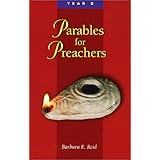
Parables for Preachers: The Gospel of Mark, Year B Review

Parables for Preachers: The Gospel of Mark, Year B
Average Reviews:

(More customer reviews)
Barbara Reid's books on 'Parables for Preachers' follow the Revised Common Lectionary. Because of this, the book for Year B concentrates primarily on the texts of the gospel of Mark. Before getting into the heart of the texts, Reid presents introductory material on parables, preaching, and the gospel of Mark. Reid states in her introduction, 'In the Synoptic Gospels, Jesus rarely explains his parables. They are meant to be wrestled with by each generation of hearers who allow themselves to be disturbed and challenged by Jesus' subversive stories.'
Subversive stories? One of the things that comfortable Christianity has sometimes forgotten is the revolutionary and radical character of Jesus and his teaching in the first century. Perhaps this is because the teachers are so familiar. How does one find new meanings in familiar parables that show up again and again? This is a particularly important question for preachers, and Reid addresses it directly.
The term 'parable' can refer to a range of types of speech - it goes beyond the simple moral stories similar to Aesop's fables. Parables in Mark carry much of the weight of Jesus' teaching.
Jesus, of course, was not the first to preach or teach in parables. In doing this, he was following an ancient and honoured tradition. This is a tradition that may be continued by modern teachers and preachers. Reid illustrates several ways in which parables serve to carry a message. They provide a way for Jesus to explain his experience of God and holiness without boxing it into academic or dogmatic statements. It helps connect the encounter with the holy with the common people and their daily lives. 'In his parables, Jesus always began with the familiar. The images and situations he painted in his stories were from the fabric of daily life of his audience.'
Of course, Jesus' parables were broad and inclusive - nothing was outside the scope of God's realm. While parables began with the familiar, they never lingered there. They served to recast 'common' creation in a new way - the realm of God. Of course, this then begs for interpretation, which is never as straightforward and simple as some preachers would have it seem. 'What catches up with the hearer is that Jesus' parables are usually open-ended; Jesus rarely interpreted these stories for his disciples.... Because they are told in figurative language, the parables are capable of conveying distinct message to different people in diverse circumstances.'
Other aspects of parables that are key to their meaning include that they are not neutral, but always have a slant or bias, often toward the more marginal in society. They are a communal endeavour, and not really meant for individualists (something that Western society tends to forget). Parables are short, which makes for easier recollection - they are small like seeds, from which much may grow. Also, the final aspect of parables is similar to that of preaching - they are meant to be heard and lived, not simply forgotten.
Understanding how to interpret parables involves several things Reid highlights. They involve understanding the gospels themselves, in their own setting. The nature of the gospels is important - what kind of writing is this, and what is its purpose? Parables fall within gospel literature, so yet another level of understanding is required. Reid gives a quick overview of different modes of interpretation, including allegorical, historical criticism, social science study, linguistic and literary approaches, as well as the new forms of liberation interpretation. Reid is quick to underscore that 'no one method provides the definitive key.' These methods are guides, but ultimately we are all charged with engaging the parables for ourselves and our communities.
As this text deals with the gospel of Mark, Reid continues with a chapter looking at the gospel of Mark, from issues of authorship, historical and social setting, documentary transmission and analysis, theological issues and overall purpose. The theological ideas of Christology, ecclesiology, and eschatology vary from gospel to gospel, as do some of the texts of the same stories. Reid highlights Mark as the earliest gospel, most likely the closest of the Jesus stories we can get to the actual time of Jesus.
The remainder of the book looks at particular parables, eight texts in all, as they appear sequentially in the liturgical year. There is a chapter devoted to each text pericope. These include parables both in the Sunday lectionary as well as the daily cycle of readings. Each section gives attention to major images, theological themes, narrative devsices, and a helpful list of preaching possibilities. This book does not provide set sermons, nor does it emphasise one theological approach exclusive to others.
Overall, this book is a very handy guide to anyone who reads the gospels, who is interested in preaching, or is interested in understanding more about one of the primary teaching/preaching devices of Jesus. Reid writes with clarity, sensitivity and care on her subjects. While she does tend toward a liberal interpretation of scripture, even evangelical and fundamentalists can find inspiration here, given that parables have never been meant to have literal interpretations placed upon them, and the multi-valent character of parables practically begs for as broad a range as possible for study. To that end, Reid has provided a generous bibliography for further research.


Click Here to see more reviews about: Parables for Preachers: The Gospel of Mark, Year B


Buy NowGet 22% OFF

Click here for more information about Parables for Preachers: The Gospel of Mark, Year B

Read More...

The Gospel According to Jesus: A New Translation and Guide to His Essential Teachings for Believers and Unbelievers Review

The Gospel According to Jesus: A New Translation and Guide to His Essential Teachings for Believers and Unbelievers
Average Reviews:

(More customer reviews)
Stephen Mitchell does something almost unforgivable in this book by stripping core tenets of the Christian faith from his "translation" of the New Testament. Something strange happens, though: God's truth shines through anyway. The author parses and paraphrases, and leaves out virtually the entire Gospel, but the reader can tell what he's aiming for.
This is not, as I see it, an attempt to rewrite the Gospel or translate the Gospel, but rather an attempt to show particular facets in an enlightening way. The reason the gross omissions are forgivable is that he takes parts of Jesus' teachings and makes them shine far more brightly than before. The parable of the Prodigal Son, in particular, receives the attention that it should. Mitchell might have problems with what he considers the more "mythological" aspects of Christianity, but his writing demonstrates a real understanding of the concepts of grace, forgiveness, and divine providence. Yes, a lot of this is because these are the facets of Christianity that dovetail with his Zen philosophy and training, but this remains the strength of the book.
What every reader should realize about this work, though, is that it cannot be considered a definitive translation of the Gospel. It is neither scholarly nor historical. Rather, it is poetic and interpretive, and the author prefers to present the gist of the text, particularly where a precise translation doesn't translate context or connotations. Obviously, the problem with this is that the author's subjective judgments can and do get in the way.
The main reason that I give this book four stars rather than three is that the author is explicitly honest about his motives and intentions, and those parts of the Gospel he chooses to translate are helpful both to unbelievers who are trying to understand Christianity and to believers as extensions to traditional Bible study.
Finally, while the whole book is technically blasphemy, it helped me return to my faith after a long hiatus. Make of that what you will.

Click Here to see more reviews about: The Gospel According to Jesus: A New Translation and Guide to His Essential Teachings for Believers and Unbelievers

A dazzling presentation of the life and teachings of Jesus by the eminent scholar and translator Stephen Mitchell.

Buy NowGet 21% OFF

Click here for more information about The Gospel According to Jesus: A New Translation and Guide to His Essential Teachings for Believers and Unbelievers

Read More...